---
title: Understanding Credit Limit Recommendations
description: This article explains what the Credit Limit is, how it is calculated, and when a Credit Limit may not be provided.
image: https://knowledge.wiserfunding.com/hubfs/Wiserfunding%20Logo%20-01%20(3).png
---
[Skip to content](https://knowledge.wiserfunding.com/credit-limits-recommendation#main-content)
English
Show submenu for translations
[File a support ticket](https://knowledge.wiserfunding.com/kb-tickets/new?hsLang=en)
![Logo\_Wiserfunding Logo -01-2.png\]](https://knowledge.wiserfunding.com/hs-fs/hubfs/Logo_Wiserfunding%20Logo%20-01-2.png?height=50&name=Logo_Wiserfunding%20Logo%20-01-2.png)
Open main navigation
Close main navigation
- English
Show submenu for translations
- [File a support ticket](https://knowledge.wiserfunding.com/kb-tickets/new)
- wiserfunding.com
wiserfunding.com
Hello. How can we help you?
- There are no suggestions because the search field is empty.
1. [Help Centre](https://knowledge.wiserfunding.com/?hsLang=en)
2. [Understanding the Credit Insights](https://knowledge.wiserfunding.com/understanding-the-credit-insights?hsLang=en)
# Understanding Credit Limit Recommendations
## This article explains what the Credit Limit is, how it is calculated, and when a Limit may not be provided.
A Credit Limit is the maximum estimated amount of additional credit that a lender could extend to a business, taking into account its existing debt obligations. It is intended to provide an indication of the company's borrowing capacity and should be considered alongside other credit assessment criteria.
To estimate the Credit Limit, Wiserfunding uses financial information, company characteristics and risk metrics. The methodology evaluates three key dimensions of a company's financial profile:
- **Earnings capacity**: representing the company's ability to generate operating earnings to support additional debt
- **Balance sheet strength**: reflecting the company's capital available to absorb potential losses
- **Asset backing**: representing the value of assets that could support borrowing
Each of these dimensions is used to estimate the maximum level of sustainable debt. The most conservative of these estimates is selected as the company's maximum debt capacity, from which existing net debt is deducted to calculate the remaining borrowing capacity (Credit Limit).
The model also incorporates the company's Probability of Default (PD), which continuously adjusts the estimated debt capacity according to the company's risk profile. This allows the Credit Limit to reflect differences in credit quality without relying on fixed rating bands, resulting in a more risk-sensitive and economically grounded assessment.
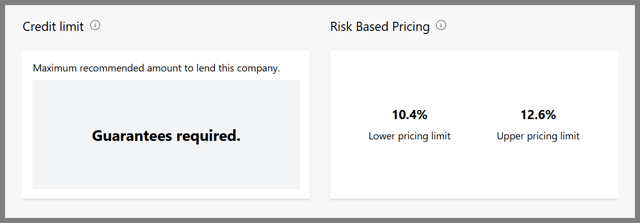
Wiserfunding will not provide a Credit Limit in the following cases and will return the corresponding message:
- - **Status** – The company is not active.
- **Financials** – The latest available financial statements are more than five years old.
- **Guarantees** – There is insufficient collateral or financial support to estimate a reliable Credit Limit.
---
If you have any further questions or face any issues, [please contact our support team.](https://knowledge.wiserfunding.com/get-more-help?hsLang=en)
- [Using the Wiserfunding Platform](https://knowledge.wiserfunding.com/using-the-wiserfunding-platform?hsLang=en#main-content)
- [Running New Reports](https://knowledge.wiserfunding.com/using-the-wiserfunding-platform?hsLang=en#running-new-reports)
- [Updating Reports | Adding More Data](https://knowledge.wiserfunding.com/using-the-wiserfunding-platform?hsLang=en#updating-reports-adding-more-data)
- [WiserAI Documents](https://knowledge.wiserfunding.com/using-the-wiserfunding-platform?hsLang=en#wiserai-documents)
- [Portfolio Management](https://knowledge.wiserfunding.com/using-the-wiserfunding-platform?hsLang=en#portfolio-management)
- [Using Wiserfunding APIs](https://knowledge.wiserfunding.com/using-the-wiserfunding-platform?hsLang=en#using-wiserfunding-apis)
- [Integrations](https://knowledge.wiserfunding.com/using-the-wiserfunding-platform?hsLang=en#integrations)
- [General](https://knowledge.wiserfunding.com/using-the-wiserfunding-platform?hsLang=en#general)
- [Understanding the Credit Insights](https://knowledge.wiserfunding.com/understanding-the-credit-insights?hsLang=en)
- [Create Users | Passwords | Contact Support](https://knowledge.wiserfunding.com/create-users-passwords-contact-support?hsLang=en#main-content)
- [Contact Support](https://knowledge.wiserfunding.com/create-users-passwords-contact-support?hsLang=en#contact-support)
- [Admin](https://knowledge.wiserfunding.com/create-users-passwords-contact-support?hsLang=en#admin)
- [Platform Release Notes](https://knowledge.wiserfunding.com/platform-release-notes?hsLang=en#main-content)
- [API Versioning Policy](https://knowledge.wiserfunding.com/platform-release-notes?hsLang=en#api-versioning-policy)
[](http://wiserfunding.com?hsLang=en)
Copyright © 2026, Wiserfunding Ltd