![Logo_Wiserfunding Logo -01-2.png]](https://knowledge.wiserfunding.com/hs-fs/hubfs/Logo_Wiserfunding%20Logo%20-01-2.png?height=50&name=Logo_Wiserfunding%20Logo%20-01-2.png)
Many SMEs do not publicly disclose their greenhouse gas emissions.
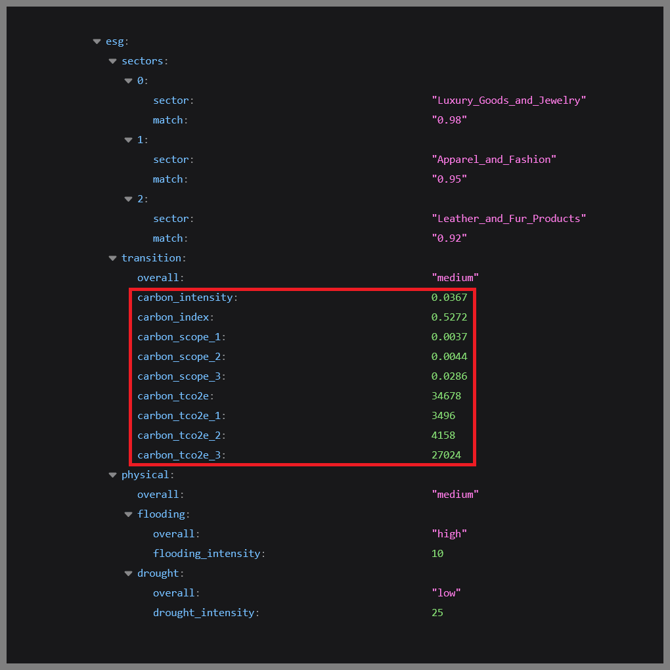
To address this data gap, Wiserfunding estimates emissions using two pieces of information that are usually available:
- The company's industry classification.
- The company's turnover (revenue).
The Wiserfunding model identifies the company's industry and applies a validated carbon intensity for that industry. Then we multiply the intensity by turnover and allocate the result across Scope 1, Scope 2 and Scope 3 emissions.
This produces an estimated operational emissions profile.
Where do the carbon intensities come from?
The carbon intensities are derived from:
- Official government emissions statistics.
- Official economic activity data.
- Industry-level greenhouse gas accounts.
- Validation against thousands of publicly listed companies that disclose emissions.
The methodology combines statistical data with real-world company disclosures to ensure that the estimates reflect observed industry behaviour.
Most SMEs do not publish emissions data. Industry-based estimation provides a transparent and consistent approach that allows emissions to be estimated across large portfolios where company-specific disclosures are unavailable. The estimates are intended to represent a typical company's operational emissions within a given industry.
How should the estimates be used?
The Carbon Metrics are designed to support:
- ESG screening
- Credit analysis
- Portfolio assessment
- Sustainability reporting
- Climate risk evaluation
They provide an evidence-based estimate where reported emissions are unavailable and should be interpreted as an industry-based approximation rather than a company-specific disclosure.
You may also find our other articles on Carbon Intensity, Index, and Emissions Scopes useful:
If you have any further questions or face any issues, please contact our support team.