![Logo_Wiserfunding Logo -01-2.png]](https://knowledge.wiserfunding.com/hs-fs/hubfs/Logo_Wiserfunding%20Logo%20-01-2.png?height=50&name=Logo_Wiserfunding%20Logo%20-01-2.png)
A credit limit represents the maximum recommended amount of credit that a lender should offer to a debtor for a particular line of credit. To compute the credit limit, we use financials, company details, and risk metrics. In particular, the credit limit is a function of:
Credit Limit = f(Net Current Assets, Equity buffer, Debt Capacity, SME Z-Score)
The underlying assumption is that, for each risk profile, a company will have a certain propensity to take on additional debt. Since debt is generally cheaper than equity, there is a trade-off between increasing indebtedness and a deteriorating risk profile. On this basis, we assume that the objective of an effective credit limit is to ensure that a company does not exceed its debt capacity - that is, the maximum amount of debt tolerated for a given credit rating.
We have used large datasets for each country and sector to empirically determine optimal debt capacity associated with each credit rating band. The difference between a company’s debt capacity and its existing level of debt provides the initial credit limit. This value is then adjusted based on the level of net current assets (which can be more readily converted into cash if debt needs to be repaid) and the equity buffer (equity that can be used, in a second instance, to absorb losses). These adjustments may increase or decrease the final credit limit depending on their characteristics.
For some SMEs, we may recommend that additional guarantees - either personal or collateral - are provided before lending. “Guarantees Required” will appear when the risk profile is low based on the data we have sourced. To enhance the data and potentially improve the outcome, you may upload more recent accounts, which will allow us to provide a revised credit limit for these SMEs.
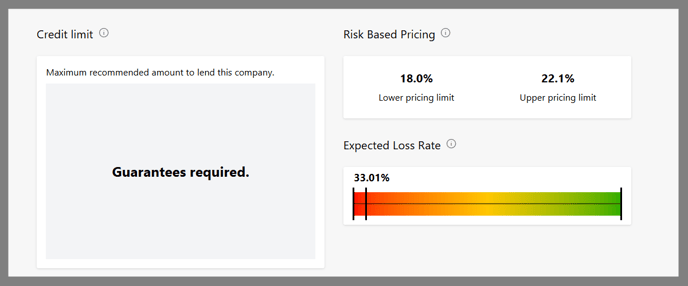
Please note that we will recommend additional guarantees in the following cases:
a. The SME status is not active.
b. The latest financials available are more than two years old.
c. The SME Z-Score is below 100.
If you have any further questions or face any issues, please contact our support team.